


Solar Smash
Paradyme Games
I came away from Solar Smash with a clear impression: it is less a conventional simulation game and more a hands-on cosmic sandbox built around destruction. I can choose a planet, experiment with different ways to damage it, watch the results unfold, and then start over without the pressure of a campaign or a difficult objective. That simple loop is exactly why it is so easy to pick up, but it is also why the experience can feel shallow if I want long-term progression.
Developed by Paradyme Games, this free simulation game has reached over 100 million installs and holds a 4.6 average from around 1.7 million ratings. Those figures make sense to me after spending time with it: the concept is immediately understandable, the visual payoff arrives quickly, and a single session can fit into a short break. The game is rated Everyone 10+, although the imagery of planets being destroyed may still be worth considering for younger players.
Why the destruction sandbox works so well
A simple idea with surprisingly satisfying feedback
The appeal is not difficult to explain. I am given a planet and a collection of destructive possibilities, then I decide how far to take the experiment. There is no complicated tutorial demanding that I learn a large rule set before having fun. The first few actions communicate the main idea naturally, while later sessions become more about trying combinations and observing how the planet changes.
Related News

Dragon City: Mobile Adventure - Unleash Your Inner Dragon Master

How Pizza Ready! Turns Restaurant Pressure Into Mobile Simulation

Solar Smash: Unleashing Cosmic Power in Mobile Culture
That immediacy is the strongest part of the design. Many simulation games ask me to manage resources, wait for construction, or follow a progression system before the interesting moments appear. Here, the interesting moment is almost always close at hand. I can open the game when I have only a little time, create a dramatic result, and leave without feeling that I abandoned a larger task.
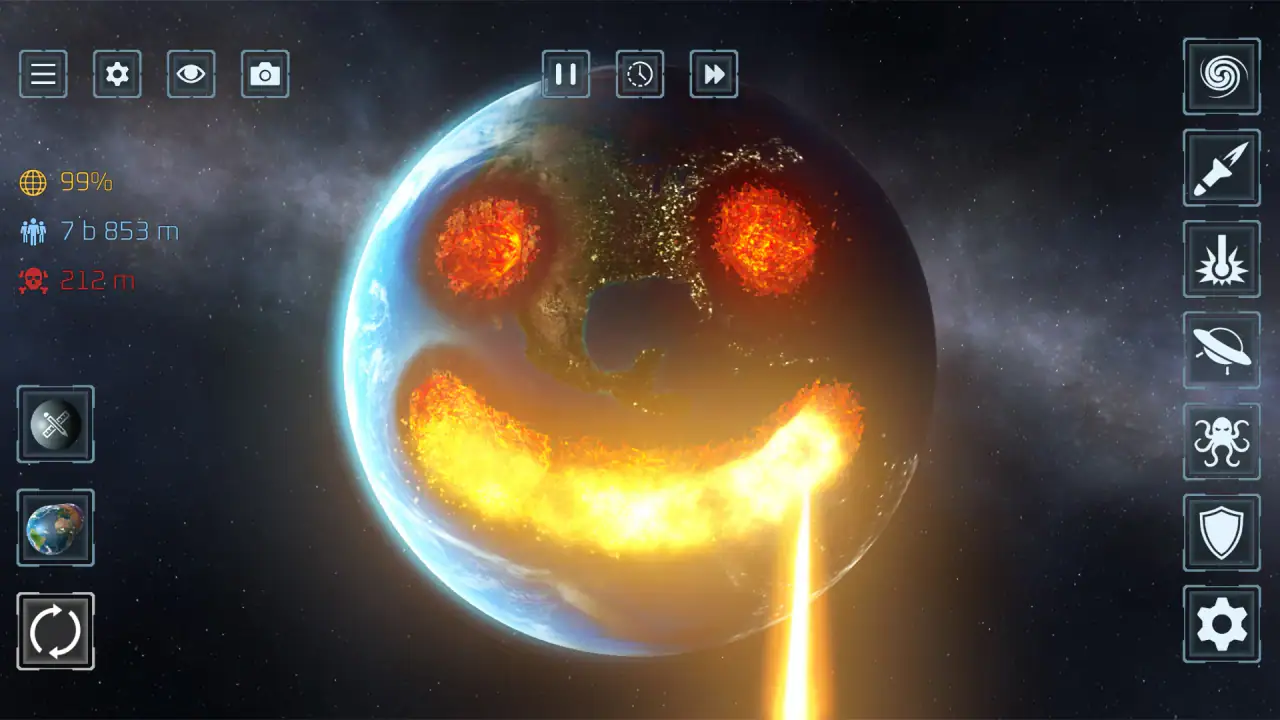
The visual presentation also gives each action a sense of consequence. A hit is not just a number disappearing from a bar; I can see the planet becoming damaged and eventually turning into something very different from the starting world. That visual change provides the motivation to keep experimenting, even when there is no traditional score to chase.
Related News

Why WhatsApp Messenger Still Makes Everyday Communication Feel Easy

Jurassic World: The Game Is the Better Dino Tycoon for Strategic Players

Threads in Real Life: Who Should Join, Lurk, or Leave

How SHEIN Turned Shopping Into an Endless Content Feed

How to Make Fortnite Feel Smarter on Mobile

Should You Switch to Microsoft Outlook on Mobile?
Experimentation is more rewarding than winning
I would not approach this as a game about mastering a single optimal strategy. Its best moments come from curiosity. I might begin with a small intervention to see how the surface responds, then switch to a more extreme approach simply to compare the result. This makes it a good fit for players who enjoy testing possibilities rather than completing missions in a fixed order.
One useful habit is to slow down instead of immediately using the most dramatic option. Starting with controlled changes makes it easier to notice how the planet evolves. After that, I can reset and repeat the same idea with a more aggressive approach. The contrast between those attempts adds structure to what could otherwise become random tapping.
Another practical tip is to treat each session as a short experiment with one question. For example, I might focus on how much damage I can create while keeping the planet recognizable, or I might deliberately build toward total destruction. This gives the sandbox a personal objective and prevents the experience from becoming a repetitive sequence of unplanned attacks.
Gallery
It works particularly well on a phone
The touch-based format suits the concept. I do not need a keyboard, a controller, or a large amount of screen space to understand what I am doing. The controls feel designed for direct interaction: choose an action, place it, observe the result, and try something else. That makes it comfortable for a quick session while waiting for an appointment or taking a short break from work.
I also like that the game does not require me to remember a complicated chain of commands between sessions. When I return after a few days, the central interaction remains obvious. That matters for a casual title because the game is competing with many other quick distractions, and any unnecessary friction would weaken its main advantage.
There is a trade-off, though. The same simplicity that makes it accessible means that players looking for a detailed scientific simulation may find it too playful. The game presents a cosmic destruction fantasy, not a rigorous educational model. I enjoy it more when I judge it by the quality of its visual sandbox rather than by whether it teaches astrophysics.
Small experiments can become their own challenges
Although the game does not need a formal mission structure to be entertaining, I found that self-imposed challenges make it last longer. I can attempt to create a specific type of damage, compare the appearance of a lightly affected planet with a heavily affected one, or see how efficiently I can reach a final state. These goals turn passive spectacle into active observation.
A particularly useful workflow is to run the same experiment twice: once quickly, and once carefully. The first attempt shows the obvious result. The second lets me place actions more deliberately and watch what changes. This approach is more interesting than simply repeating the strongest attack because it encourages me to pay attention to timing, positioning, and the order in which I use the available tools.
That is also where the game shows a strength that a short store description cannot communicate. Its replay value does not mainly come from collecting items or building a permanent empire. It comes from the freedom to frame the same sandbox differently each time. For some players, that is enough; for others, the lack of a deeper long-term structure will become noticeable quickly.
What the large audience tells me—and what it does not
The scale of its audience is useful context. With more than 100 million installs, this is clearly not an obscure experiment that only appeals to a tiny group of simulation enthusiasts. Its 4.6 average across roughly 1.7 million ratings suggests that the straightforward destruction concept connects with a broad mobile audience.
Still, popularity does not remove the need to understand the format. A large number of players may enjoy a game for a few minutes at a time without wanting to spend weeks with it. I see Solar Smash in that category: it is easy to recommend as a casual sandbox, but I would not promise the depth of a management simulator, a strategy campaign, or a physics-focused construction game.
The main weakness is limited long-term purpose
My biggest reservation is the absence of a strong reason to keep returning once the novelty has faded. The first sessions are naturally engaging because I am discovering what the sandbox can do. Later, the experience depends heavily on whether I enjoy creating my own experiments. If I need unlockable goals, a story, competitive rankings, or a sense of building toward something, I may run out of motivation.
This is not a minor distinction. In a management simulation, a slow start can lead to a satisfying payoff as systems grow more complex. In a strategy game, a difficult objective can make every decision meaningful. Here, the reward is primarily visual and immediate. Once I have seen the kinds of outcomes that interest me, the game asks me to supply the next reason to play.
I also found that the spectacle can become repetitive when I use the same approach repeatedly. The solution is to vary the way I play, but that solution depends on personal creativity rather than on the game constantly presenting fresh objectives. Players who prefer guided content should know this before downloading it.
Free access is welcoming, but purchases deserve attention
The game is free to download, which makes it easy to try without making a commitment. Optional in-app purchases range from $2.49 to $2.99 per item. I would recommend treating the free version as the real test: spend enough time deciding whether the core sandbox itself is enjoyable before considering any purchase.
For me, the important question is not whether a purchase exists, but whether the basic experience already provides enough variety for the way I play. If I only want an occasional destructive session, free access may be sufficient. If I become interested in exploring everything available, I should keep track of spending rather than making several small purchases automatically.
This is also a game I would be comfortable letting a family member try with a conversation about purchases first. The Everyone 10+ rating is relatively broad, but the combination of a free entry point and optional items makes device-level purchase controls sensible, especially on a shared phone or tablet.
Who should install it?
I think Solar Smash is at its best for curious casual players, fans of visual simulations, and anyone who enjoys a toy-like sandbox without a demanding learning curve. It is also a good choice for people who want something that can be played in short bursts. A teenager looking for a quick creative distraction, or an adult wanting a few minutes of low-pressure experimentation, will probably understand its appeal immediately.
It may also suit players who enjoy showing results to friends. The destruction is visually direct, so it is easy to explain what I am doing without a long introduction. A quick demonstration can be more entertaining than a conventional tutorial because the result appears on screen almost at once.
I would skip it if my priority is a persistent world, detailed resource management, realistic science, or a campaign with meaningful character development. A planet-building simulator would be a better choice for someone who wants to nurture and expand a world. A strategy game would be more suitable for someone who wants decisions to lead toward a win or loss. Solar Smash is about controlled spectacle, not sustained progression.
How it compares with other simulation choices
Compared with city-building games, this title removes nearly all of the administrative work. I do not need to balance budgets, place roads, or wait for a population to grow. That makes it much faster to understand, but it also means I lose the satisfaction that comes from building a complex system over time.
Compared with physics sandboxes, it offers a more focused fantasy. I am not constructing elaborate machines or solving engineering problems; I am exploring the visual consequences of attacking a planet. That narrow theme gives the game a strong identity, even though it limits the range of activities available.
Compared with traditional space simulations, it is far less concerned with accuracy and planning. I would choose this when I want immediate interaction rather than orbital calculations or a long chain of technical decisions. The trade-off is clear: accessibility and spectacle replace realism and depth.
Version, compatibility, and everyday practicality
The current version is 2.6.5, and the game supports Android 7.0 or later. That relatively accessible requirement means it can work on a range of devices that are not running the newest operating system. Even so, I would keep expectations realistic on older hardware: a visually active simulation can feel less comfortable if a device struggles with rendering or becomes warm during play.
In everyday use, I would keep sessions short when playing on a phone with limited battery life. The game is naturally suited to brief bursts, so there is little reason to leave it running in the background or treat it like a long continuous session. That habit also helps preserve the novelty instead of exhausting the central idea in one sitting.
The game was released on January 19, 2020, yet its continued visibility shows that the core concept has held up. I do not read that longevity as proof that it offers endless depth. I read it as evidence that a clear, instantly understandable sandbox can remain appealing when it delivers its main pleasure without delay.
My practical recommendation
If I were recommending it to a friend, I would describe it as a digital destruction toy with simulation elements rather than as a full-scale simulation career. I would suggest trying it when the goal is relaxation, curiosity, or a quick visual distraction. I would also explain that the best way to extend its life is to invent focused experiments instead of expecting a conventional progression system to keep supplying goals.
Before spending money, I would play several different kinds of sessions: a fast destructive run, a careful comparison, and a session built around a personal challenge. If all three feel entertaining, the game is probably a good match. If the first spectacle is fun but the second attempt already feels empty, additional content may not solve the underlying issue, because the main appeal is the sandbox itself.
My final view is positive but specific. Solar Smash is a strong short-session cosmic sandbox, not a deep long-term simulation. Paradyme Games has made the central interaction accessible, visually immediate, and easy to revisit when I want a few minutes of experimentation. Its limitations are equally clear: repetition arrives sooner for players who need structured goals, realism, or progression.
For the right audience, that focus is a strength rather than a flaw. I enjoy it most when I stop looking for a campaign and treat each planet as a blank canvas for a small experiment. If that sounds like your kind of entertainment, the free download makes trying it straightforward. If you want a game that remembers your achievements, steadily expands a world, or challenges you with complex decisions, I would point you toward a more traditional simulation instead.
FAQs for Solar Smash
What is Solar Smash and how does it work?
Solar Smash is a planet destruction simulator available on Android and iOS. Players can choose from a variety of weapons and scenarios to unleash on a planet, watching the effects in real-time. The game features realistic graphics and physics, allowing users to experiment with different destructive tools and witness their impact on celestial bodies.
Is Solar Smash free to download and play?
Yes, Solar Smash is free to download and play. However, it may contain in-app purchases that offer additional content or features. These purchases are optional, and players can enjoy the core experience without spending money. It's a great way to explore the game's features before deciding if you want to enhance your experience further.
What devices are compatible with Solar Smash?
Solar Smash is compatible with both Android and iOS devices. For Android, it typically requires version 5.0 or higher, while iOS users need iOS 10.0 or later. It's essential to check the specific system requirements in the Google Play Store or Apple App Store to ensure compatibility with your device.
Does Solar Smash require an internet connection to play?
No, Solar Smash does not require an internet connection to play. This makes it a great option for offline entertainment, allowing users to enjoy the game anytime, anywhere. However, an internet connection might be needed for downloading updates or accessing additional content offered through in-app purchases.
Are there any ads in Solar Smash?
Yes, Solar Smash does contain ads. These advertisements help support the developers and maintain the game's free status. While ads may appear during gameplay or between sessions, they are generally not intrusive. Players can often remove ads through in-app purchases if they prefer an uninterrupted experience.
Pros
- Impressive graphics and visual effects.
- Wide range of planets to explore.
- Interactive and engaging gameplay.
- Regular updates with new features.
- Easy to understand and navigate.
Cons
- Limited replayability after a while.
- Ads can be somewhat intrusive.
- Some features require in-app purchases.
- Occasional bugs and crashes.
- Lacks a storyline or campaign mode.


